
Women March for Peace: Black Radical Women’s Anti-Korean War Activism
The Korean War is commonly known as the “forgotten war” because it supposedly had little impact on American culture in comparison to World War II or the American War in Vietnam. Yet from 1950–1953, the conflict produced vigorous anti-war activism, particularly among Black radical women. Informed by their experiences with racism and misogyny within the US, these women were convinced that peace was not just the absence of military aggression, but that it required the liberation of the most oppressed, including the end of capitalist exploitation of women and People of Color and the return of self-determination to colonized peoples—themes that later anti-war activists would echo and develop. Whether or not the Korean War has ever truly been forgotten, the visionary activism of these women has been largely overlooked

Claudia Jones: Visions of a Socialist America
Activist, journalist, and visionary Claudia Jones was one of the most important advocates of emancipation in the twentieth century. Arguing for a socialist future and the total emancipation of working people, Jones’s legacy made an enduring mark on both sides of the Atlantic.
This ground-breaking biography traces Jones’s remarkable life and work, beginning with her immigration to the United States and culminating in her advocacy for the emancipation of the most oppressed. Denise Lynn reveals how Jones’s radicalism was forged through confronting American racism, and how her disillusionment led to a life committed to socialist liberation. But this activism came at a cost: Jones would be expelled from the US for being a communist. Deported to England, she took up the mantle of anti-colonial liberation movements.
Despite the innumerable obstacles in her way, Jones never wavered in her commitments. In her tireless resistance to capitalism, racism, and sexism, she envisioned an equitable future devoted to peace and humanity – a vision that we all must continue to fight for today.
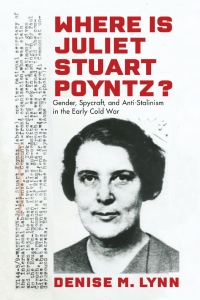
Where is Juliet Stuart Poyntz? Gender, Spycraft, and Anti-Stalinism in the Early Cold War
On a sweltering June evening in 1937, American Juliet Stuart Poyntz left her boardinghouse in Manhattan and walked toward Central Park, three short blocks away. She was never seen or heard from again. Seven months passed before a formal missing person’s report was made, since Poyntz worked for the Soviet Secret Police and her friends (many of whom were anti-Stalinist radicals in the United States) were scared to alert authorities. Her disappearance coincided with Josef Stalin’s purges of his political enemies in the Soviet Union and it was feared that Poyntz was a casualty of Soviet brutality.
In Where Is Juliet Stuart Poyntz?, Denise M. Lynn argues that Poyntz’s sudden disappearance was the final straw for many on the American political left, who then abandoned Marxism and began to embrace anti-communism. In the years to follow, the left crafted narratives of her disappearance that became central to the Cold War. While scholars have thoroughly analyzed the influence of the political right in the anti-communism of this era, this captivating and compelling study is unique in exploring the influence of the political left.
Reviews
G. Donato. Review of Lynn, Denise M., Where is Juliet Stuart Poyntz?: Gender, Spycraft, and Anti-Stalinism in the Early Cold War. Choice: Publication of the Association of College and Research Libraries, Vol. 59, Issue 5 (2022): 725
James G. Ryan. Review of Lynn, Denise M., Where is Juliet Stuart Poyntz?: Gender, Spycraft, and Anti-Stalinism in the Early Cold War. Journal of American History, (September 2022): 477-478.
 Denise Lynn, Ph.D.