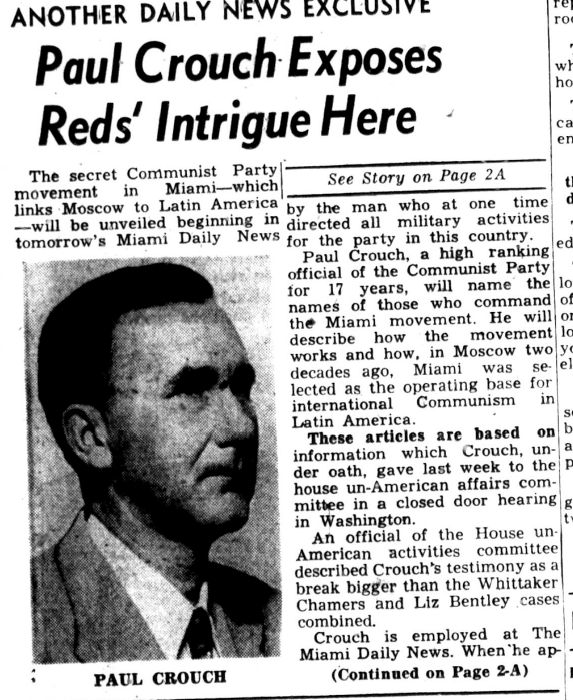
Paul Crouch was another former communist who tried to cash in on his time in the Party. As his biographer Gregory Taylor argues, Crouch had a “Manichean perspective” – he saw the world in black and white – communist or anticommunist. After he left the Party in 1942, he stayed quiet for awhile. Then when he lost his job and needed to find a source of income he turned to anticommunism.
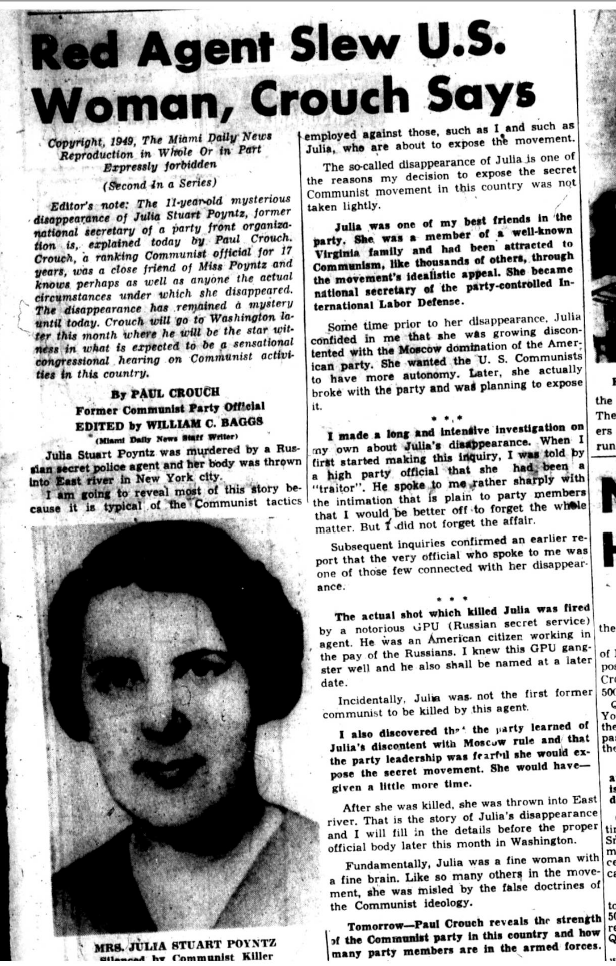
In 1949, Crouch did a series of articles for the Miami Daily News revealing scintillating details about the communist underground. In the May 10 edition Crouch accusing George Mink of killing Juliet Stuart Poyntz. Crouch said that Poynz was a close personal friend though he called her Julia and erroneously said she was from New England. The reaction to Crouch’s claims were explosive. The story was carried nationwide in several newspapers and caught the attention of local law enforcement and the FBI.
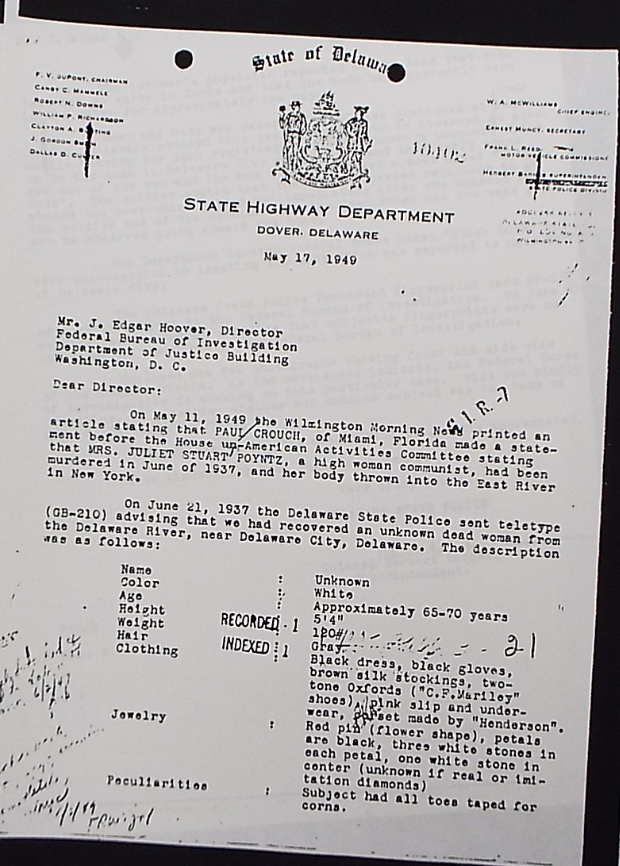
The FBI had shown little interest in Poyntz when she went missing and Herbert Solow and Carlo Tresca urged the Bureau to do an investigation; which it did not bother to do until much later when it would benefit them. For some reason though both Louis Budenz and Benjamin Gitlow had been talking about Poyntz for three years, it was Crouch’s allegations that made people pay attention. The Bureau began to receive inquiries from local law enforcement agencies trying to match missing persons files.
In one case, the Delaware Highway Patrol contacted the Bureau about a body they found in the Delaware River in June 1937. They sent the Bureau her dental records and fingerprints in hopes they could identify the Jane Doe. Unfortunately, the Bureau did not have Poyntz’s fingerprints on file; she had been arrested on a few occasions, including in Boston in 1924 after she called Calvin Coolidge “an errand boy of the capitalist system.”
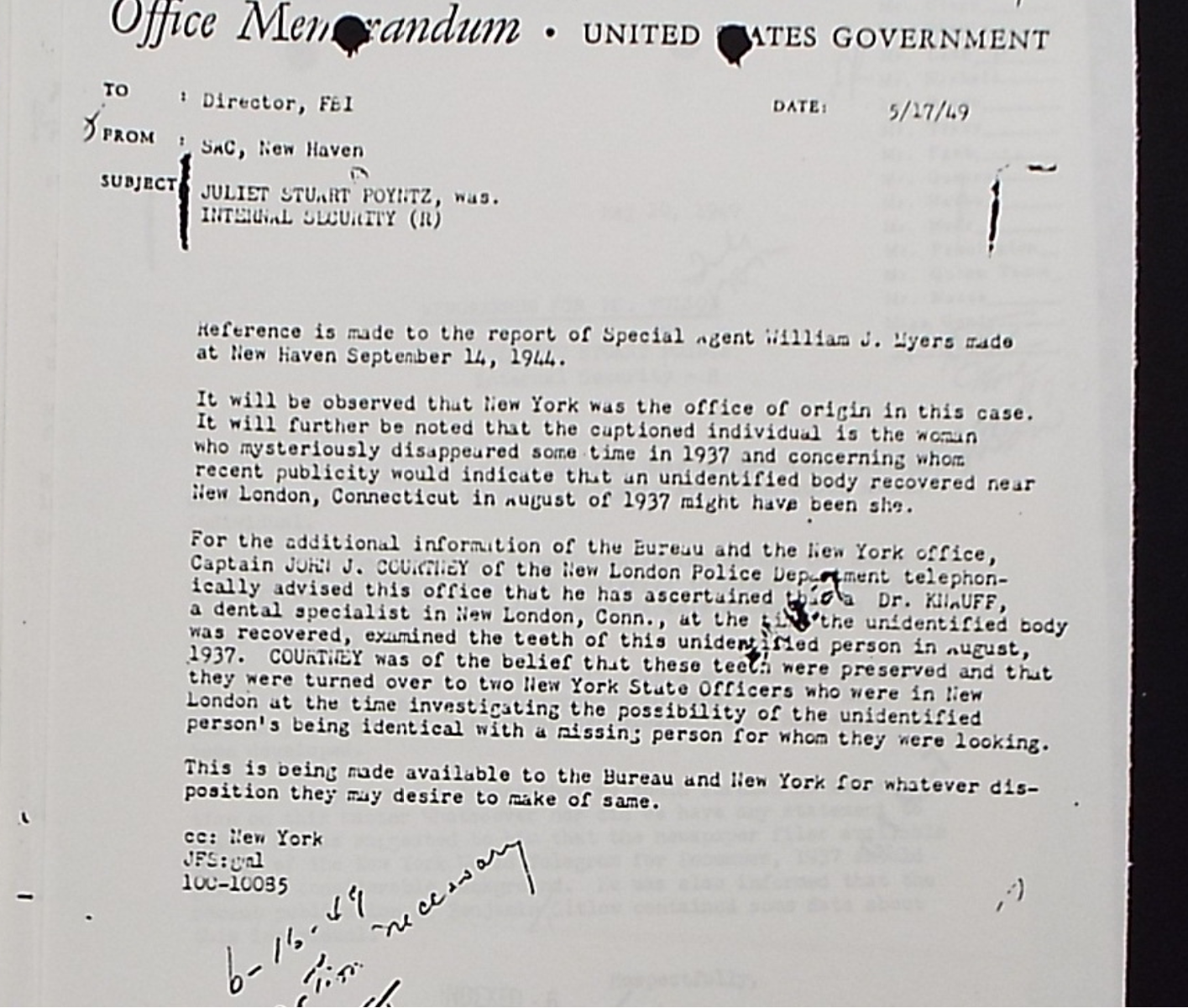
But the lack of fingerprints would not have mattered, the poor unclaimed woman’s body was significantly older, had dentures, and was a few inches shorter than Poyntz (though some agents wondered if the body could shrink in water.) Sadly, there were several women’s bodies that went unclaimed that some thought could be Poyntz; around the same time that Poyntz went missing Alice Parsons, a New York heiress also disappeared. It appeared that depression America was no safer for women than today.
Paul Crouch began working as a professional witness and began writing a memoir. But as Taylor argues he was an inconsistent and unreliable witness. He often contradicted himself and sometimes gave information on people he previously said he did not know. The FBI did not think it was worth questioning him on Poyntz because it did not give his accusations much credence. Plus he did not say anything new, he was only repeating the same accusations that started with Tresca. Attorney General Herbert Brownell decided not to use him as a witness any more and media sources were keeping tabs on Crouch’s falsifications in the “Crouch Appendix.” In 1955, Harvey Matusow, a former communist and professional witness, published his book False Witness in which he revealed that he had lied in anticommunist hearings and he accused Crouch and Elizabeth Bentley of lying too. Crouch tried to get the FBI to help him clear his name because this cut off his main source of income, but he was becoming a liability. In 1955 he died from lung cancer putting to end a dubious career as a professional witness.
 Denise Lynn, Ph.D.