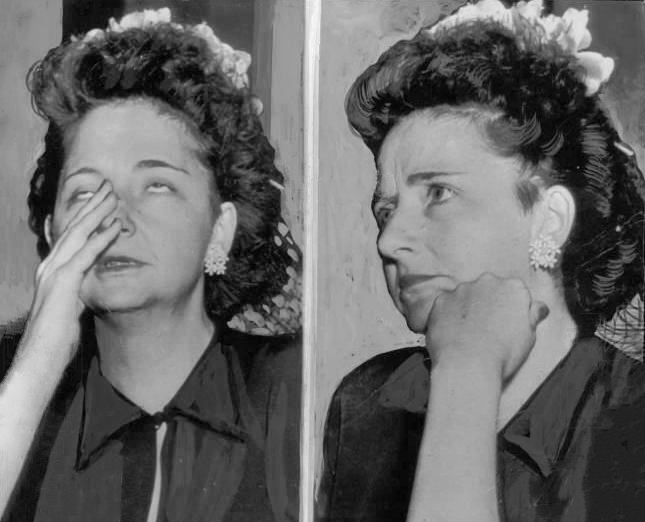
When Juliet Stuart Poyntz went missing in 1937, the men that discussed her disappearance saw her as a victim. Specifically, it was Carlo Tresca and Herbert Solow who argued that the Soviet Union had her killed. It was their stories that would be repeated over the next eighty years. Interestingly, because Poyntz went missing in the 1930s, she could still be a victim. The women like Elizabeth Bentley who were outed as spies in the 1940s were harangued and vilified. Kathryn Olmsted, Bentley’s biographer, argues that Bentley would face misogyny and harassment for her appearance and her lifestyle while she tried to create an image of herself as the “communist June Cleaver.”
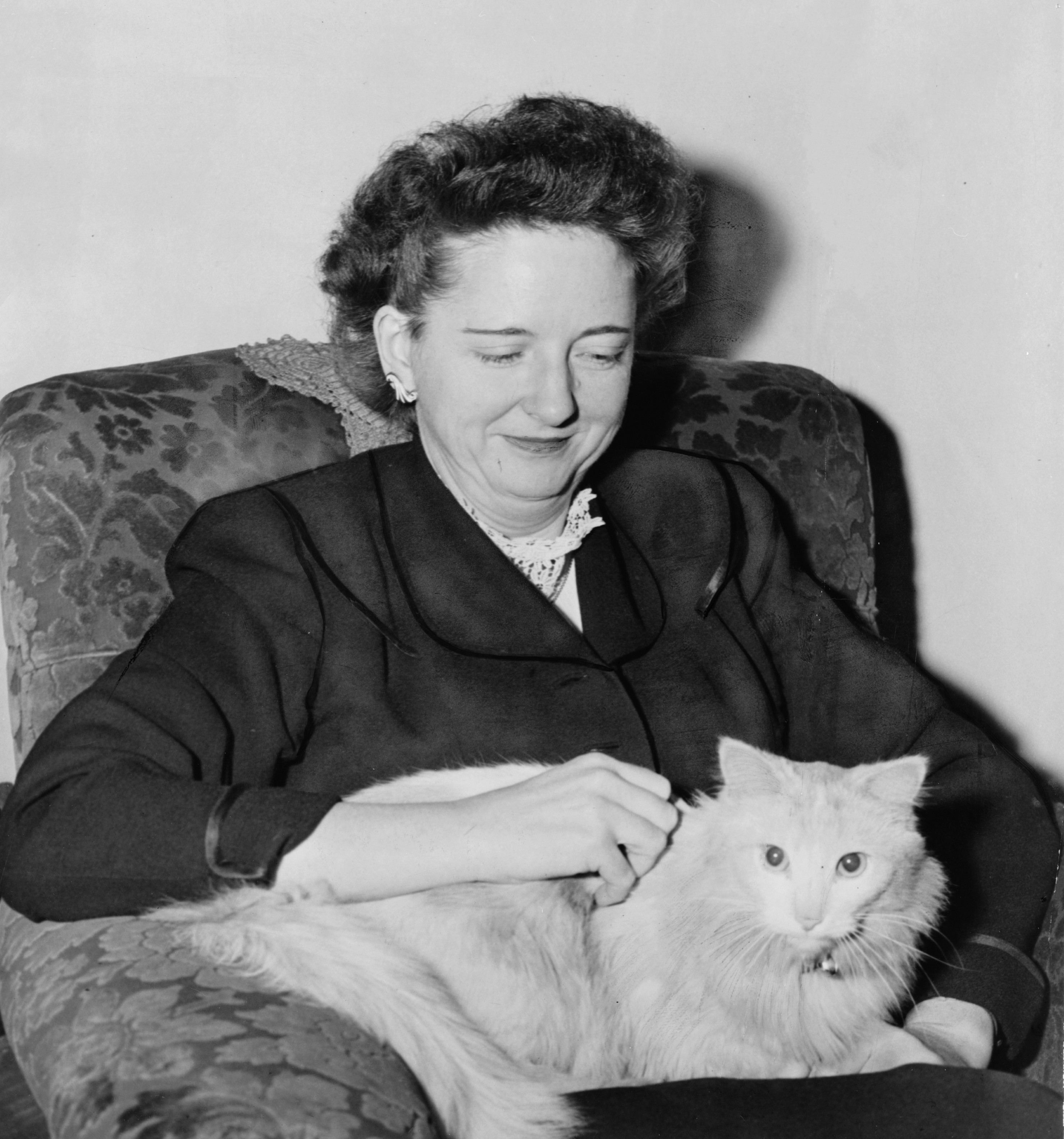
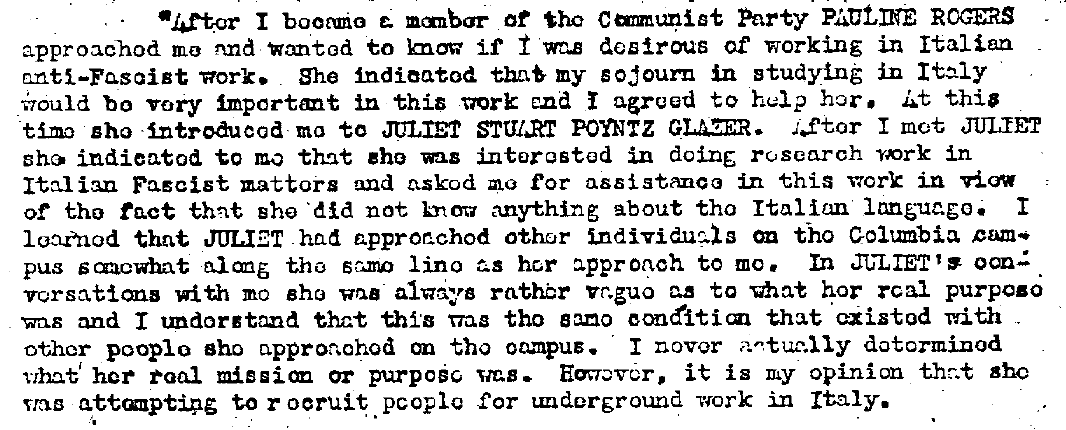
Bentley would be a charismatic and controversial anticommunist witness. She joined the Communist Party in 1935, perhaps out of loneliness but also because of the growing anti-fascist sentiment in the United States. Bentley had studied in Italy and was fluent in the language, she could be useful to the anti-fascist underground and Poyntz tried to recruit her but failed. The reasons she failed are hard to pinpoint because Bentley gave different accounts. Bentley approached the FBI in 1945 out of fear that she would be outed as an agent. She gave a statement to the FBI that described Poyntz’s attempt to recruit her. There was little embellishment or drama, though she did state that she heard Poyntz had been killed.
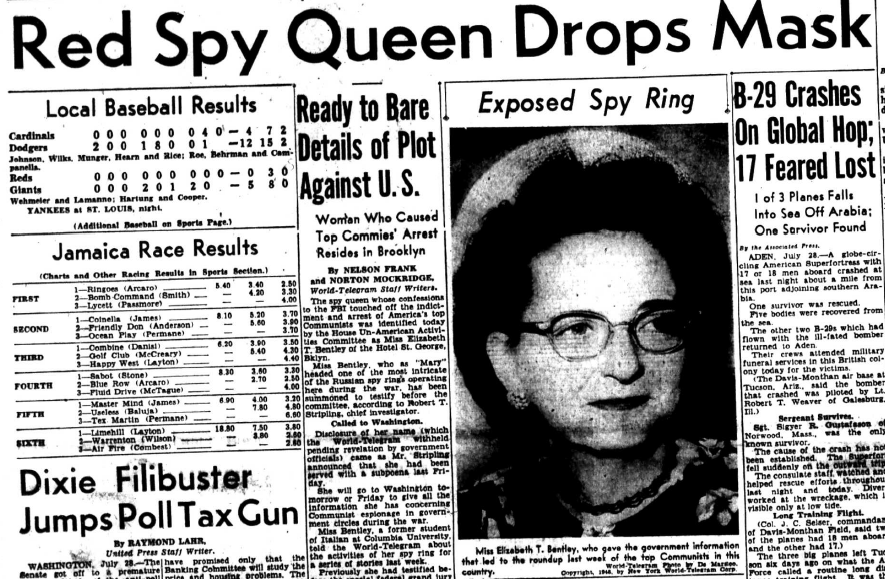
Bentley stayed in the underground at the FBI’s urging until 1948. She was unmasked when she began to testify before House Committees and in courts. Before that happened she contacted two journalists from the New York World Telegram, hoping to control her image. Unfortunately, the series of articles that appeared in the newspaper referred to her as the “Blond Spy Queen” and occasionally just “the Blonde” playing off popular culture tropes of spies. This set up expectations of a sexy and sultry spy leading to disappointment when Bentley’s “mask” was dropped. Kathryn Olmsted argues that these articles set the stage for Bentley’s struggles with the media who chose to focus primarily on her appearance.
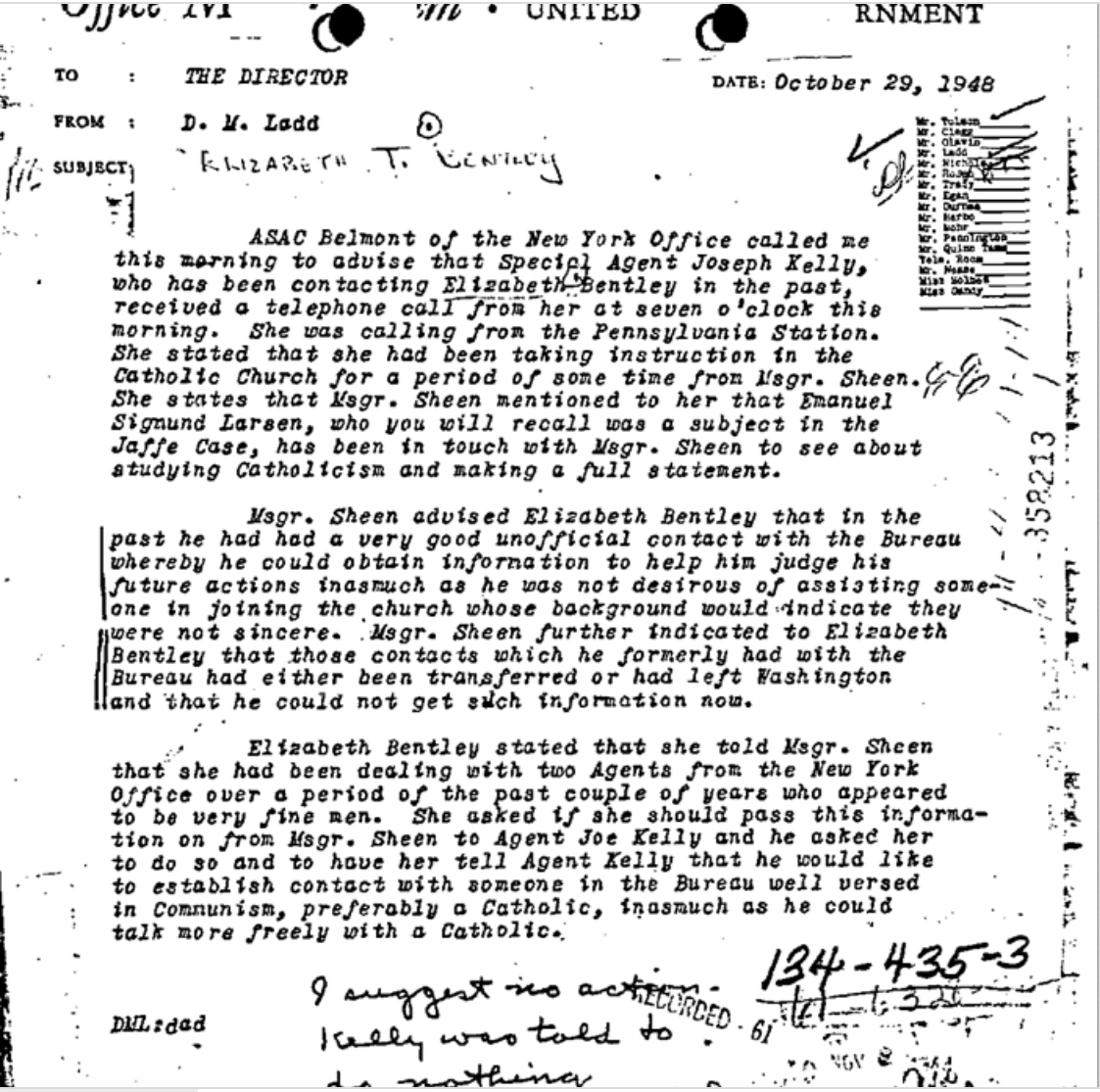
Bentley wanted to cash in on the anticommunist trend; she needed an income because she was having a hard time holding down a job, especially since the FBI used her as a witness and she had to be available. She also had made a conversion to Catholicism at the urging of Louis Budenz. She spoke with Monsignor Fulton Sheen who suggested she write a book. The FBI was not thrilled with the idea.
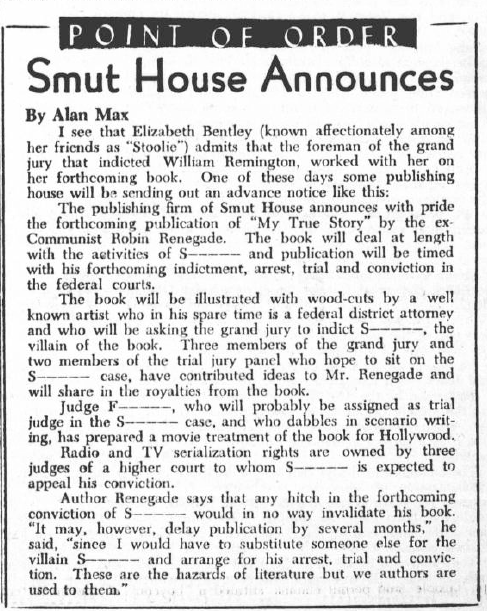
Nevertheless her book Out of Bondage was published in 1951. Olmsted believes that Bentley was not the sole author of the text getting help from two others including John Guilland Brunini, an anticommunist and the jury foreman at the trial of William Remington. The book was widely pilloried in the liberal and left press, especially given its melodramatic writing and tone.
More importantly, in the book Bentley describes Poyntz in far seedier terms than she did to the FBI. She accused Poyntz of being a hard-drinking, sex fiend and herself as an innocent. As Olmsted argues, the alcoholic Bentley known to have multiple lovers would not have been found wanting if that was required in the Soviet underground. Poyntz was depicted as a bully, frightful, angry, and devious. Bentley’s claims were far fetched; many mainstream reviewers found the book a serious disappointment.
Bentley would become a thorn in the FBI’s side. Unable to hold down a job and with regular problems with her lovers, Bentley frequently turned to the Bureau for help. In 1963, she died at only 55 years old.
 Denise Lynn, Ph.D.