After Juliet Stuart Poyntz returned to the United States she became more involved in political action. Glaser, who was a socialist, had been estranged from his family because of his politics. It is possible he influenced her politically. Poyntz’s interest in labor conditions led her to a job with the Rand School of Social Science where she taught courses on women and labor. The Rand school founders were all socialists and wanted to study social conditions as a way to seek radical change.
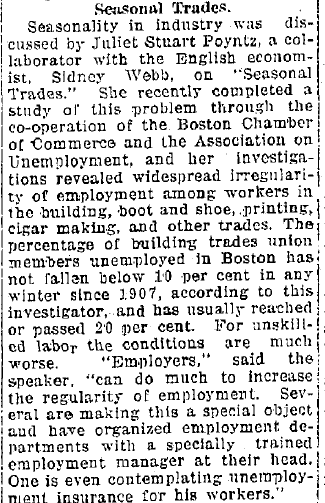
Poyntz also did some work with the American Association for Labor Legislation (AALL). The AALL advocated a federal health insurance program based on those in Europe. Poyntz did research for it on women’s labor conditions and unemployment.
In 1915, Morris Hillquit, one of the founders of the Socialist Party, recruited Poyntz to work for the Local 25 Waist and Dressmaker’s Union, a union in the International Ladies Garment Workers Union (ILGWU). Poyntz became an educational director creating institutions to help working women, including unity house where the women could gather. She was also editor of the local’s magazine The Message.

Poyntz met a number of important people at the Rand School and in the ILGWU that would influence her political life. Marie MacDonald who ran the Catskill Unity House, a house in the Catskill mountains where women workers would go for vacation. She also met her lawyer and friend Elias Lieberman.
Poyntz also met Schachno Epstein, the editor of the ILGWU’s Jewish newspaper Gerechtigkeit. Some would later claim that the two were lovers, though technically Poyntz was still married. Epstein returned to the Soviet Union in 1917 after civil war broke out there. Carlo Tresca would later claim that Epstein was involved in Poyntz’s disappearance.
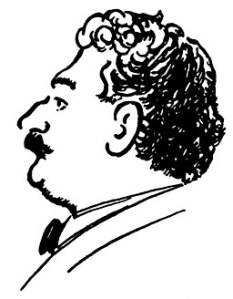
Poyntz joined the Socialist Party (SP), but became increasingly more radical as American Socialists became more moderate. One of her closest friends in the Party was Ludwig Lore, the head of the German language branch and editor of Volkszeitung, a German language paper.
In 1919, Vladimir Lenin invited all Socialist Parties to the Communist International (Comintern) the proposed replacement for the Socialist International. This set off vicious debates within the SP. Poyntz and Lore sided with the sect that broke from the SP and joined the Comintern. It was called the Workers Party of America (WPA), but would later be renamed the Communist Party of the United States (CPUSA).
In 1924, Lenin died. Before his death internal leadership conflicts led to division with the Soviet Communist Party that reverberated to the WPA. Lore and Poyntz were in a left-wing faction which sent Moissaye Olgin to Moscow to seek guidance. Lore’s faction was condemned because it allegedly resembled Leon Trotsky’s; Lore was expelled from the Party in 1925. Because Poyntz would not condemn Lore, she came into conflict with the Party leadership.
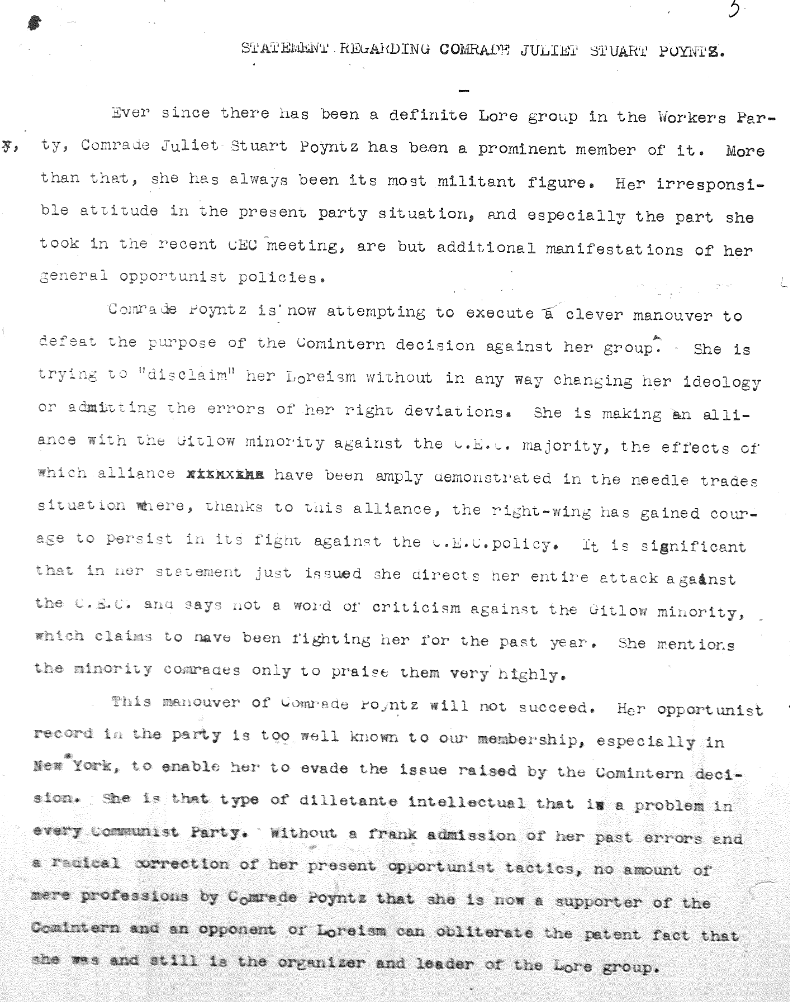
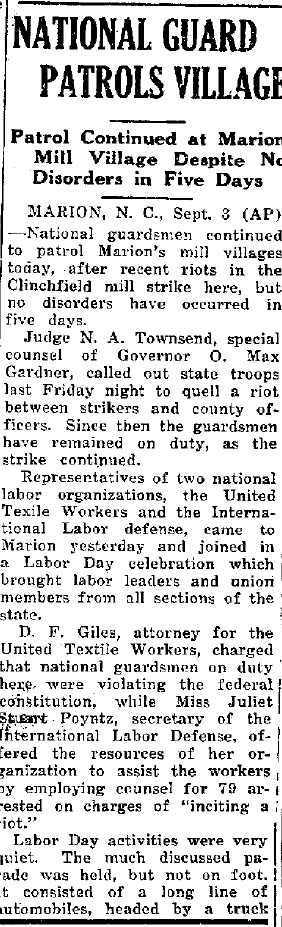
Poyntz was nearly expelled as well but she apologized and remained. After this she rose in the ranks of the CPUSA, becoming secretary of the International Labor Defense (ILD) in 1929. The ILD was a legal organization that defended “class war prisoners.” She was secretary of the organization during the infamous Gastonia Strike of textile workers in North Carolina. During the strike, violence broke out. In one incident the police chief O.F. Aderholt was killed. Fred Beal, a union organizer, and dozens of other strikers were arrested. The trial captivated the nation, but the violence continued and a striker and ballad singer Ella May Wiggins was killed. Poyntz organized throughout the strike and was arrested at least once.

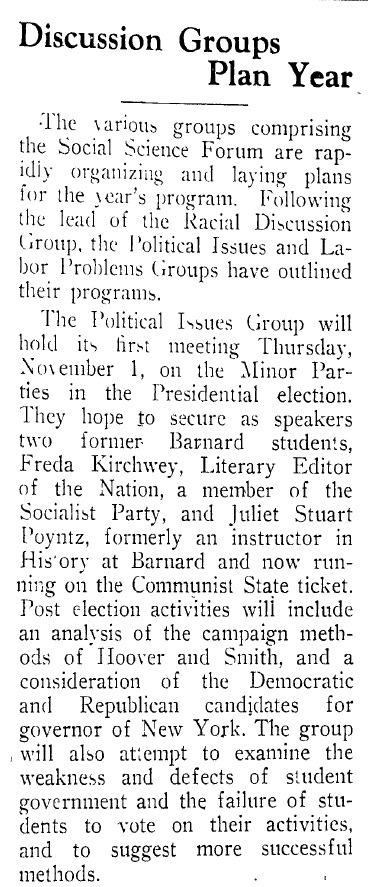
Poyntz continued her work in the Party as an organizer and speaker. She also ran for political office, first in 1926 for New York State Comptroller, then again in 1928 for Attorney General. She lost both elections, but was proving valuable to the CPUSA. By 1934, Poyntz was estranged from her family and her former husband who would die in 1935. With few obligations, Poyntz seemed to be a perfect candidate to move into the Soviet Underground.
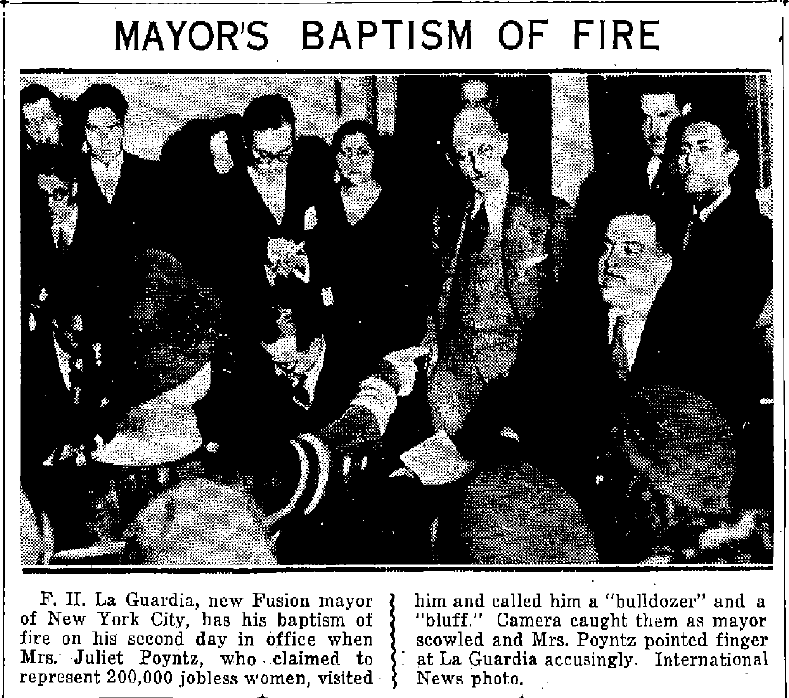
The rise of fascism across Europe troubled American communists, especially since communists became targets in Nazi Germany and the Soviet Union was vulnerable. Fascism presented a very real threat to everything the CPUSA fought for and it felt that the United States government was not doing enough to stop its spread. Poyntz went underground in 1934 to do anti-Nazi work. Her last known public appearance was when she faced off with Mayor Fiorello LaGuardia. La Guardia was using the Great Depression to secure for himself expansive powers. Poyntz marched women down to his office to demand relief and to protest his attempts to seize more control. The image below shows the back of Poyntz’s head as she points directly at the mayor. Its an image that shows her clear determination in the face of the powerful.
 Denise Lynn, Ph.D.