
By 1937, Herbert Solow, like his friend Carlo Tresca was an anti-Stalinist. In his younger years he was drawn to Marxist theory and he worked on the radical Jewish magazine the Menorah Journal. He traveled to the Soviet Union, but was disenchanted by what he found. He also met Leon Trotsky while he was in exile in Turkey and began to favor Trotskyism. But the Show Trials and the Great Purge disenchanted Solow who moved further to the right politically. By Juliet Stuart Poyntz‘s disappearance in 1937, Solow was a fervent anti-Stalinist and by the postwar years he would be an anticommunist.
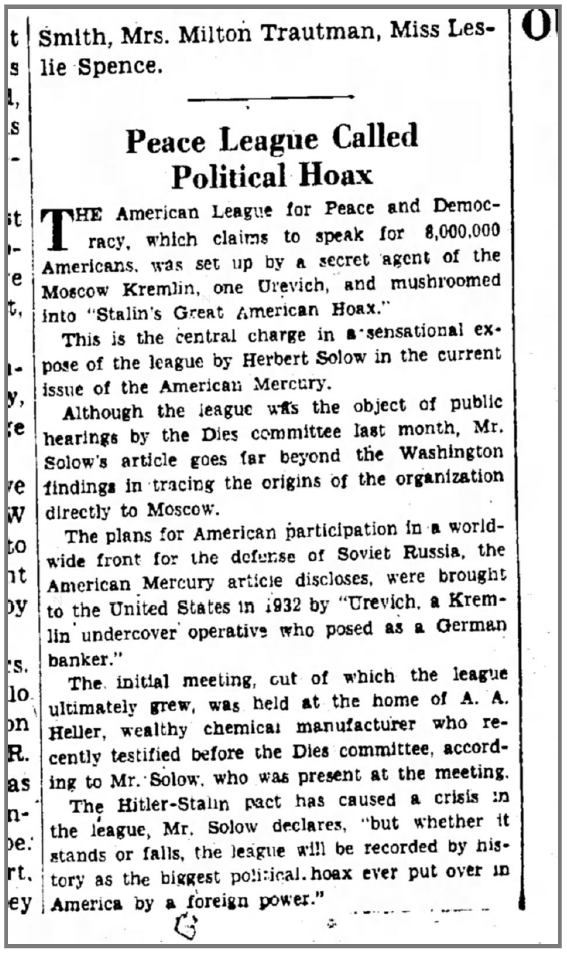
Much like Tresca, Solow regularly attacked any action or organization linked to the American Communist Party. He was active in trying to undermine the American League for Peace and Democracy, a group with several Communists members. He was convinced that all American Communists were agents of Stalin, and that Stalin pulled the strings on every action that Communists took. Operating without evidence, Solow was increasingly driven by his anti-Stalinism.
When Poyntz went missing and the Robinsons-Rubens were arrested, Solow insisted, along with Tresca, that the Soviets were plotting against American citizens. Even worse, he believed that American communists were complicit, a charge he never managed to prove.
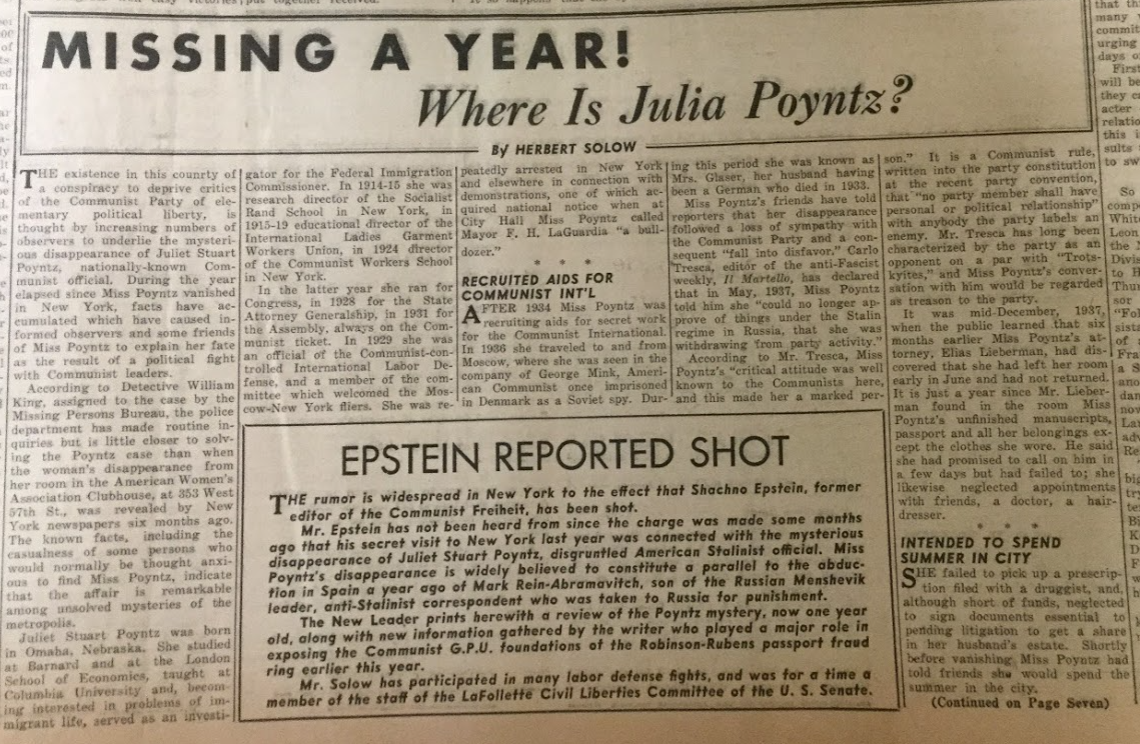
Solow began to investigate Poyntz’s disappearance, he also tried to get the Federal Bureau of Investigation (FBI) interested in the case. He called agents, wrote letters to J. Edgar Hoover, and made contacts with people Poyntz had recruited into the underground to try and uncover what happened. He was not successful.
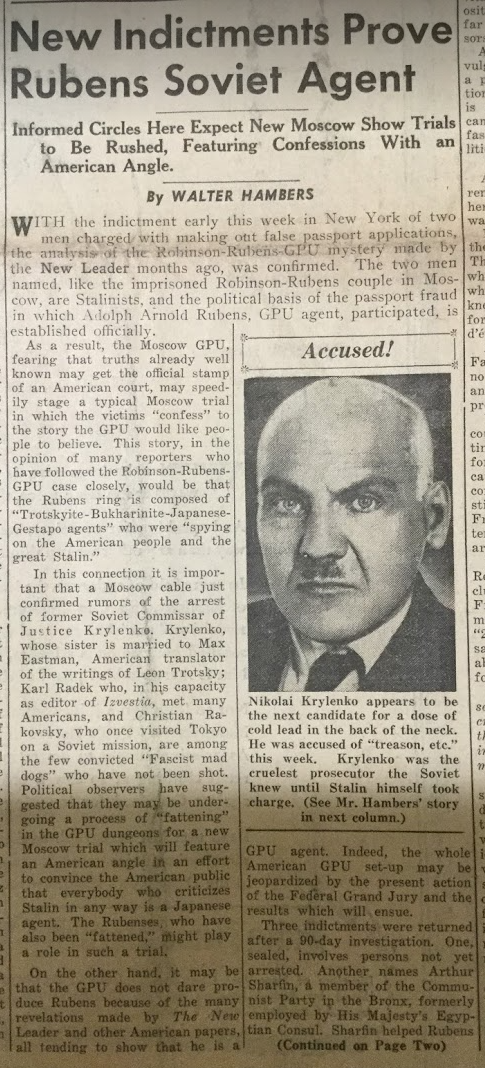
Sometime in 1938 his old college classmate Whittaker Chambers, another American working as a Soviet spy, was trying to leave the Communist Party. He contacted Solow who immediately asked him if he knew anything about Poyntz’s disappearance. He claimed to know nothing, though during the Cold War, Chambers would change his story and weave a narrative about Poyntz’s disappearance and alleged murder using already available media stories. After this first meeting, Solow tried to get in contact with Chambers again by writing under an assumed name in the New Leader, a name that was an anagram of Chambers own, like Walter Hambers. It did not work, but the two would reconnect and begin to swap stories about what they believed happened to Poyntz.
 Denise Lynn, Ph.D.